Cart
0

Table of Contents
- Why Your Jeans Size and Your Waist Measurement Are Not the Same
- How to Measure Jeans Waist Flat for the Most Accurate Number
- How to Measure Your Body Waist for Jeans
- How to Measure Waist for Jeans Without a Tape Measure
- How to Measure Hips for Jeans to Complete Your Sizing
- Using a Jeans Waist Size Chart to Find Your Match
- Troubleshooting Fit: Stretch, Shrinkage, and Rise
- Conclusion: Measure Once, Wear Confidently
- Frequently Asked Questions
Last Updated: October 9, 2026
Why Your Jeans Size and Your Waist Measurement Are Not the Same
A pair of jeans labeled size 30 does not measure 30 inches around the waistband.
A garment measurement is the physical waistband of the jeans, measured flat. A body measurement is the circumference of your own waist.
At Urban Mode Wear Store, we hear from shoppers every week who ordered their "usual size" and got a gap at the back or a squeeze at the hip.
Here is what we cover below:
- How to measure jeans waist flat in two steps
- How to measure your body waist correctly
- What to do without a tape measure
- How to read a jeans waist size chart
Key Takeaway
Your jeans size and your waist measurement are two separate numbers. Measure both, then compare them to the size chart. Never assume the tag equals your waist.
How to Measure Jeans Waist Flat for the Most Accurate Number
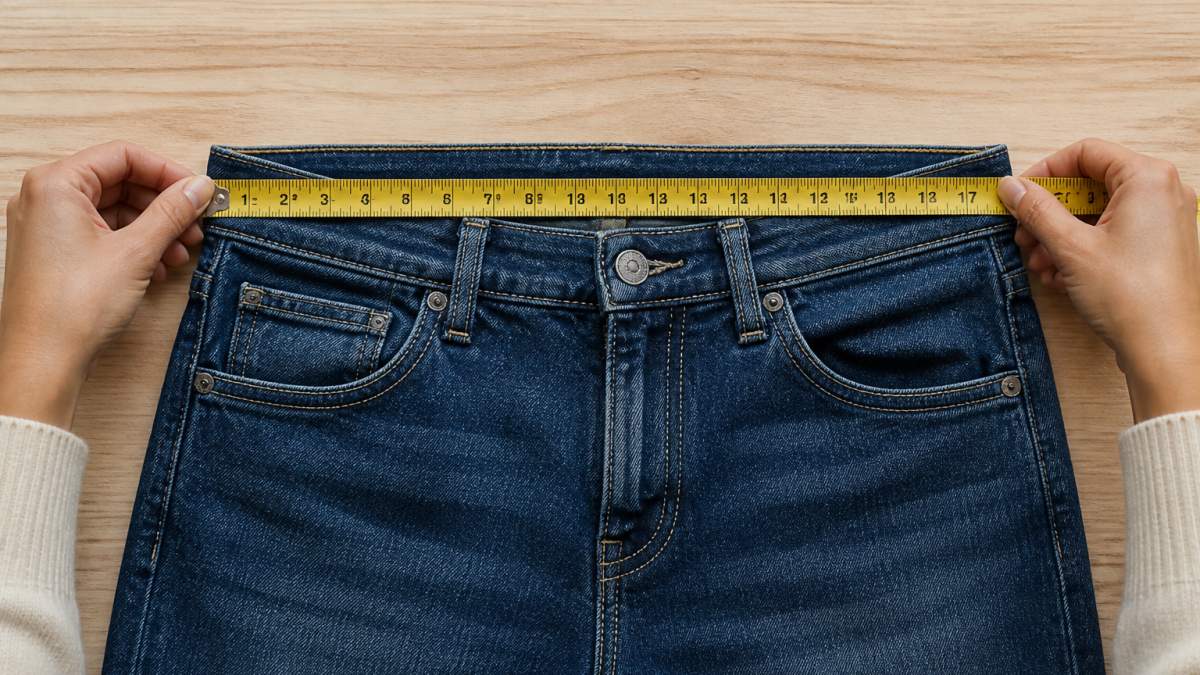
The most accurate way to measure jeans is to lay them flat, button the waistband, and measure straight across from one side to the other. Then double that number. This gives you the full waist circumference of the garment.
You need a flat surface, a flexible measuring tape, and a pair of buttoned jeans. That is it.
Step 1: Button and Smooth the Waistband
Button the jeans and lay them flat on a table or the floor. Smooth the waistband with your hands so it lies level, with no twists or folds. A wrinkled waistband will throw off your number.
Step 2: Measure Across and Double the Number
Place the tape at one edge of the waistband and pull it straight across to the other edge. Keep the tape parallel to the floor. Note the number in inches or centimeters. Now double it.
If the flat measurement reads 15 inches, the full waist circumference is 30 inches. That is your half-waist measurement, and doubling it is the step most people skip.
Pro Tip
Measure the back waistband too, not just the front. On jeans with a higher back rise, the back edge often sits higher and reads slightly wider. Use the larger of the two numbers for a truer fit picture.
How to Measure Your Body Waist for Jeans
To measure your body waist for jeans, wrap a flexible measuring tape around your natural waist, keep it level, and note the number where the tape meets. This is your body measurement, and it is the number a jeans waist size chart is built around.
Stand naturally. Do not suck in or puff out. Wear thin clothing or measure against your skin for the most accurate reading.
Where to Place the Tape for the Best Fit
Find your natural waist, the narrowest point of your torso, usually just above the navel. That is where most jeans are designed to sit. If you wear your jeans lower, on the hips, measure at that point instead and note it separately.
Keeping the Tape Level and Snug
Keep the tape parallel to the floor all the way around. Check it in a mirror if you can. The tape should sit snug against your skin without pulling tight or leaving a gap. One finger should slide under it, no more.
Breathe out normally before you read the number. Holding your breath changes the measurement.
How to Measure Waist for Jeans Without a Tape Measure
No flexible measuring tape? Use a piece of string, a ribbon, or a phone charging cable.
For the flat method, lay the jeans on the floor and use a sheet of standard printer paper as a rough guide.
Neither method beats a real tape measure for precision. But both get you close enough to pick a size when you are ordering in a hurry.
How to Measure Hips for Jeans to Complete Your Sizing
Waist is only half the picture. Hip measurement decides whether jeans will pull across the seat or hang loose.
Stand with your feet together. Wrap the tape around the fullest part of your hips and rear, usually 7 to 9 inches below your natural waist. Keep the tape level and snug.
Compare that hip measurement to the size chart alongside your waist number. If your waist and hips fall into two different sizes, size up and plan for a belt or a tailor.
New autumn and winter double waisted wide leg straight leg pants →
Watch Out
Ordering by waist alone is the most common sizing mistake we see. A pair that fits your waist but pinches at the hip will sit unworn in the closet. Always check both numbers against the chart.
Using a Jeans Waist Size Chart to Find Your Match
A jeans waist size chart maps body measurements to labeled sizes. The trap is that the number on your tape and the number on the chart are often not the same kind of measurement. Before you compare anything, know which number you are holding.
- Body waist circumference: the tape around your middle, all the way around. This is what most size charts are built on.
- Garment flat half-waist: the jeans laid flat, measured straight across one side of the buttoned waistband. This is half the garment, not your body.
- Garment full waist: the flat half-waist doubled. This is the number that can sit next to a body measurement.
If you measured your jeans flat and got 15 inches, do not look for 15 on the chart. Double it to 30 inches first.
A Worked Example, Start to Finish
Say your jeans measure 15.5 inches across the flat waistband, and your body waist measures 31 inches.
- Double the flat measurement: 15.5 x 2 = 31 inches of garment waist.
- Convert if the chart is metric: 31 inches x 2.54 = about 78.7 centimeters.
- Find 31 inches (or roughly 79 cm) on the chart's body-waist column.
- Check your hip measurement against the same row before you commit.
In this example the garment waist and your body waist land on the same number, which is a good sign the cut runs true. When the garment waist reads smaller than your body waist by an inch or two, that is normal on stretch denim, because the fabric is meant to relax and mold to you.
Reading the Chart
| Your Waist (in) | Your Hip (in) | Common Label | Fit Note |
|---|---|---|---|
| 25-26 | 35-36 | 25-26 | Snug, true to size |
| 27-28 | 37-38 | 27-28 | Standard fit |
| 29-30 | 39-40 | 29-30 | Roomier through hip |
| 31-33 | 41-43 | 31-33 | Size up if between |
| 34-36 | 44-46 | 34-36 | Check rise before ordering |
Charts vary by brand, cut, and rise. Always use the chart on the product page, not a generic one, and check whether it lists body measurements or garment measurements. Some brands publish both, and mixing them up will cost you a return.
For a real example, our double waisted wide leg straight leg pants list a size M waist of 73 cm, which converts to about 28.7 inches. If your body waist measures 28 inches, that M lands right in your range.

Pro Tip
If a chart gives you a single waist number with no unit label, assume centimeters on imported denim and inches on domestic labels, then convert to be sure. Guessing the unit is how a 79 becomes a 31-inch mistake.
Troubleshooting Fit: Stretch, Shrinkage, and Rise
Denim moves, and so does the point where it sits on your body. Two pairs with the same labeled waist can fit completely differently once rise, fabric, and wash history enter the picture. Here is what actually changes the number.
Rise Moves the Measurement Point
Your natural waist is the narrowest part of your torso, usually just above the navel. A high-rise jean is cut to sit there, so a natural-waist measurement lines up well with its waistband. A mid-rise sits an inch or two below, where your body is already a little wider.
That means the same body can need a different labeled size in a high rise versus a low rise, even from the same brand.
Stretch Denim Relaxes, Rigid Denim Shrinks
Most modern denim contains a small percentage of elastane, spandex, or a similar stretch fiber. A common pattern is that stretch denim relaxes roughly half a size to a full size after a few hours of wear, then tightens back up somewhat after a wash and dry. Rigid, 100 percent cotton denim does the opposite over time: it can shrink slightly with hot water and high heat, and it does not stretch back out the way a blend does.
Practical rules that follow from that:
- Stretch denim: buy snug, not tight. If it feels slightly compressive but not painful in the fitting room, it will likely relax to comfortable.
- Rigid denim: buy your true measured size, and expect a small amount of shrink on the first hot wash.
- Wash cold, dry low or hang dry. Hot water and high heat are the fastest way to shrink denim and distort the waistband.
- Re-measure after a few washes. Fabric can shift, and your true garment number may change by a fraction of an inch.
Why the Same Labeled Size Fits Differently Across Brands
Labeled waist sizes are not standardized. A size 30 from one brand can measure closer to 31 or 32 inches of actual garment waist, a practice often called vanity sizing. Cut, fabric content, and the brand's target fit all push the real number around.
When you are between sizes, the safer move depends on the fabric. On stretch denim, size down if the larger size feels loose at the waistband. On rigid denim, size up and plan for a belt or a tailor.
Watch Out
If a pair gaps at the back but fits everywhere else, that is usually a rise-and-curve mismatch, not a size problem. A tailor can take in the waistband. If it pinches at the hip, size up instead.
Best For
Shoppers between two sizes who want a flattering fit without the gap. On stretch denim, buy snug and let it relax. On rigid denim, buy true and tailor the waist if needed.
Conclusion: Measure Once, Wear Confidently
Getting the right fit starts with two numbers: your body waist and the flat waistband of the jeans. Measure both, compare them to the size chart, and you remove most of the guesswork from ordering denim online.
At Urban Mode Wear Store, we build our denim around flattering fits for every curve, with plus size friendly options and premium materials that hold their shape.
Ready to find your pair? Add to Cart and see how a measured fit changes the way denim feels.
Frequently Asked Questions
How do you measure your waist for jeans?
To measure your waist for jeans, wrap a flexible measuring tape around your natural waist, which is the narrowest part of your torso above your belly button. Keep the tape parallel to the floor and snug against your skin without pulling it tight. Write down the number in inches. This body measurement is the starting point for comparing against a brand's size chart.
Why does my waist measurement differ from my jeans size?
Your body waist measurement and your jeans size label are two different things. A jeans size is a garment measurement that includes fabric ease, so a pair labeled 28 may actually measure 29 or 30 inches at the waistband. Stretch denim adds another variable. Always compare your body measurement to the brand's specific size chart rather than assuming the label number matches your waist.
How do you check your waist size for jeans without a tape measure?
If you do not have a flexible tape measure, use a piece of string, a ribbon, or a phone charging cable. Wrap it around your waist where you want the jeans to sit, mark where the ends meet, then lay that length against a ruler or a printed paper ruler. You can also measure a pair of jeans that already fits you well by laying them flat and doubling the waistband width.
Should you measure your waist over or under your clothes?
Measure over a thin layer of clothing or directly against your skin for the most accurate result. Bulky fabrics like sweaters or thick sweatshirts can add half an inch or more to your measurement. If you are measuring over jeans you already own, that is fine for a garment measurement, but for body measurement, keep it to one light layer or none at all.