Cart
0
Table of Contents
- The Real Price Gap Between Premium Denim and Fast Fashion
- Where Your Money Goes: An Itemized Breakdown of a Pair of Jeans
- Fabric and Sourcing: Why Premium Fabrics Cost More Than Cheap Cotton
- Labor, Working Conditions, and the True Cost of Low-Cost Production
- Premium Jeans vs Fast Fashion Jeans: Construction and Durability Compared
- How to Tell If Jeans Are Good Quality Before You Buy
- The Cost per Wear of Premium Jeans: A Worked Example
- How to Care for Premium Denim So It Earns Its Price
- Frequently Asked Questions
Last Updated: October 20, 2026
The Real Price Gap Between Premium Denim and Fast Fashion
A pair of jeans can cost $30 or $300, and both will cover your legs. The gap between those price tags is not marketing fluff. It comes down to fabric weight, how the seams are sewn, who made the garment, and how many times you can actually wear it before it falls apart.
At Urban Mode Wear Store, we spend a lot of time explaining this to customers who ask why our denim sits above fast-fashion prices.
Below, we break down exactly where your money goes, how to spot the difference in the fitting room, and when premium denim is genuinely worth the extra spend.
Where Your Money Goes: An Itemized Breakdown of a Pair of Jeans
A jeans price tag is not one number. It is a stack of costs, and the fastest way to understand the premium-versus-fast-fashion gap is to see how each layer changes between a $30 pair and a $200 pair.
Here is a representative anatomy of a pair of jeans, using round, illustrative figures to show proportion rather than any single brand's books:
| Cost Layer | Fast-Fashion Pair (~$30 retail) | Premium Pair (~$200 retail) | What the Difference Buys |
|---|---|---|---|
| Fabric | Roughly $3-$5 | Roughly $25-$45 | Heavier cotton, longer staple length, sometimes selvedge woven on slower looms |
| Cut, sew, and finish labor | Roughly $2-$4 | Roughly $20-$40 | Skilled operators, lower units per hour, more handling per garment |
| Hardware and trims | Under $1 | Roughly $3-$8 | Solid metal shank buttons, copper rivets, leather or heavy paper patches |
| Washing, dyeing, and finishing | Roughly $1-$3 | Roughly $8-$20 | Indigo rope dyeing, hand sanding, laser or ozone finishing, lower chemical load |
| Fit development and grading | Cents per unit, amortized over huge volume | Several dollars per unit, amortized over smaller runs | Multiple fit blocks, real-body wear testing, more sizes and inseams |
| Freight, duties, and logistics | Roughly $1-$2 | Roughly $5-$12 | Smaller shipments, more expensive per-unit transport, sometimes domestic or near-shore production |
| Brand overhead and marketing | Thin per unit, spread across enormous volume | Higher per unit, spread across fewer units | Design staff, photography, customer service, returns handling |
| Retail margin | Thin percentage on high volume | Higher percentage on lower volume | Full-price selling, fewer markdowns, specialty retail |
The pattern is not that premium denim spends more on one line item. It spends more on almost every line item, and the fabric and labor lines move the most.
Two mechanisms explain most of the difference. First, volume: a fast-fashion style may run hundreds of thousands of units, so fit development, pattern grading, and marketing costs are divided across a huge base.
Key Takeaway
The price gap is not one big number. It is a stack of small decisions, and fabric weight plus seam construction are the two that most directly affect how long the jeans last. If you want to compare two pairs fairly, compare the fabric and labor layers first.
Fabric and Sourcing: Why Premium Fabrics Cost More Than Cheap Cotton
Fabric is usually the largest single cost in a pair of jeans, and it is where the price difference starts.
Weight is measured in ounces per square yard. Lightweight denim feels soft on day one but stretches out and wears thin at stress points.
Sourcing adds another layer. Mills that produce consistent, durable textiles charge more because they invest in better raw cotton and tighter quality control. Organic cotton and selvedge denim, woven on slower shuttle looms, cost more per meter than mass-produced rolls.
That is not snobbery. It is physics and economics. Slower looms produce less fabric per hour, and better cotton costs more per bale.
Labor, Working Conditions, and the True Cost of Low-Cost Production
Low-cost production is largely a math problem about time. When a factory is paid per piece, the fastest way to hit a price is to sew faster, inspect less, and pay workers less. Ethical production reverses that trade-off.
Brands that commit to fair wages and safe working conditions build those costs into the price.
This is the part of the price tag shoppers never see. You are not paying for a label. You are paying for the conditions under which the garment was made, and for the durability that skilled hands produce.
Watch Out
A rock-bottom price usually means something was cut. If a pair of jeans costs less than a decent meal, the savings came from somewhere: thinner fabric, faster sewing, or lower wages. Ask which one.
Premium Jeans vs Fast Fashion Jeans: Construction and Durability Compared
The construction gap shows up fastest at the seams, but the real story is denim-specific: how the fabric is woven, how it is dyed, how densely it is stitched, and how the hardware is set.
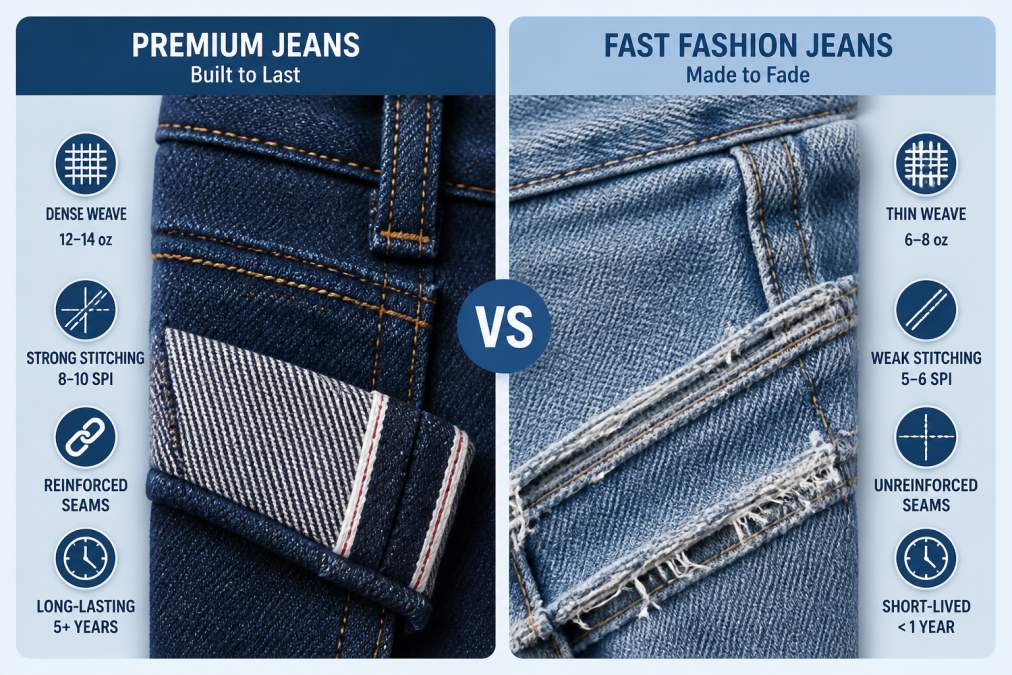
Here is how the two compare on the details that decide lifespan:
Men's Stacked Jeans - Individual Patched, Long Tight Fit Trousers for Bold Style →
- Fabric weight. Denim is measured in ounces per square yard. Fast fashion often sits around 8-10 oz, which feels soft immediately but thins at the knees and inner thighs. Premium denim commonly runs 12-14 oz, sometimes heavier for raw or selvedge styles; it takes longer to break in but holds shape and resists blowouts.
- Selvedge versus wide-loom fabric. Selvedge denim is woven on shuttle looms that produce a narrow, finished edge, slower and in smaller batches. Wide-loom fabric is faster and cheaper. Selvedge is not automatically better for every wearer, but the slower weave typically produces a denser, more stable cloth.
- Dyeing method. Premium indigo is often rope-dyed so the core stays white and the surface fades with wear, which is why well-made raw denim develops character. Cheap denim is often piece-dyed or overdyed to hide inconsistency, and it fades flat and gray rather than revealing wear patterns.
- Stitch density. Look at stitches per inch. Premium jeans commonly run 8-10 stitches per inch on main seams; fast fashion may run 5-7. Denser stitching with proper thread tension resists seam failure, while loose stitching pulls apart under stress.
- Seam type and finishing. Premium jeans use felled or double-needle seams and cleanly finished interior seams; fast fashion often uses simple overlock seams that fray. Chain-stitched hems, common on premium denim, also stretch and recover better than lock-stitched hems.
- Stress-point reinforcement. Bar tacks at pocket corners, belt loops, and the fly are standard on premium jeans and frequently omitted on cheap ones. A missing bar tack is where a blowout starts.
- Hardware. Solid metal shank buttons and copper rivets hold up; thin stamped hardware bends, tarnishes, or pulls through the fabric. Rivets set with proper burrs protect the pocket corners.
- Fit engineering. Premium brands develop multiple fit blocks and grade them across sizes and inseams, then wear-test on real bodies. Fast fashion often uses one block pattern and minimal grading, which is why the same size fits differently across styles.
Durability is the payoff. A well-constructed pair survives repeated washing and daily wear without losing shape. A fast-fashion pair often develops thinning, stretched knees, or split seams within a season of regular use.
How to Tell If Jeans Are Good Quality Before You Buy
You can judge jeans quality in about sixty seconds in the fitting room, without any label. Start with the fabric, then check the seams, then test the fit.
Run this checklist before you commit:
- Pinch the fabric. Heavier denim feels substantial, not papery, between your fingers.
- Stretch the waistband. Good denim snaps back; cheap denim stays stretched.
- Check the seams. Look for tight, even double stitching and no loose threads.
- Find the bar tacks. Pocket corners and belt loops should have reinforced stitching.
- Inspect the hardware. Buttons and rivets should feel solid, not flimsy.
- Read the fiber content. Higher cotton content generally means better shape retention.
- Move in them. Sit, squat, and walk. Good jeans move with you without gapping.
Fit matters as much as fabric. A pair that gaps at the waist or pulls at the hips will not get worn, no matter how well it is made. That is why we build our fits around real body shapes, including plus-size options, rather than forcing every customer into one block pattern.
The Cost per Wear of Premium Jeans: A Worked Example
Cost per wear is the price of a garment divided by the number of times you actually wear it. It is the single most useful number for judging whether premium denim is worth the money.
Here is a worked example using our own pricing:
| Pair | Price | Wears Before Replacement | Cost per Wear |
|---|---|---|---|
| Fast-fashion jeans | $30 | 30 wears | $1.00 |
| Urban Mode Wear Store Women's Premium Stretch Cropped Kick Flare | $30 | 150 wears | $0.20 |
| Urban Mode Wear Store Men's Stacked Jeans | $74.99 | 300 wears | $0.25 |
The math is simple: a cheap pair worn thirty times before it wears out costs a dollar per wear. A better-made pair worn far longer costs a fraction of that.

This is the argument premium denim makes for itself. You are not paying more overall. You are paying once, upfront, for a garment that keeps earning its price every time you put it on.
Pro Tip
Track your cost per wear for one season. Most shoppers discover their "cheap" jeans were the most expensive item in their closet per wear, because they replaced them twice as often.
How to Care for Premium Denim So It Earns Its Price
Premium denim rewards good care. Wash less often, wash cold, and air dry to protect the fabric and stitching that justify the price.
Follow these habits:
- Wash inside out to reduce fading and protect the surface.
- Use cold water and a gentle cycle to avoid shrinkage and stress on seams.
- Skip the dryer when you can; air drying preserves fabric weight and shape.
- Spot clean small marks instead of full washes.
- Fold, don't hang, to avoid stretching the waistband.
- Repair early. Fix a loose seam before it becomes a blowout.
Care extends garment lifespan, and lifespan is what makes the cost per wear math work in your favor. Treat the denim well and it will outlast several fast-fashion replacements.
When you are ready to invest in denim built to last, browse our premium jeans collection, from the Women's Premium Stretch Cropped Kick Flare to the Men's Stacked Jeans, and add a pair that earns its price every wear.

Frequently Asked Questions
Why are some jeans so expensive?
Price reflects what goes into the garment. Premium denim uses longer-staple cotton, denser weaving, and slower finishing, and the people who sew it are paid more. Retail markup and markdowns also shape the tag. A pair that costs more at checkout often carries a higher fabric and construction cost, while fast fashion keeps prices low through thin fabric, simplified sewing, and high-volume low-cost production.
What makes premium denim different from fast-fashion jeans?
Premium denim typically starts with better cotton, often organic cotton or selvedge denim woven on slower looms. Construction is denser, with reinforced seams and hardware that does not pull loose. Fast fashion uses lighter fabric, fewer stitches per inch, and shortcuts in washing and finishing. The result is that premium denim holds its shape and resists wear, while cheap jeans thin out and lose structure after a few months of regular use.
Are premium jeans worth the higher price?
It depends on how often you wear them. If a pair of premium jeans costs $120 and lasts three years of twice-weekly wear, the cost per wear lands under a dollar. A $30 pair replaced every eight months can cost more per wear over the same period. Premium denim is worth it when the fit works for your body and you will wear the jeans often. It is not worth it if the cut sits in your closet.
How should you care for premium denim so it lasts longer?
Wash cold and inside out, and only when the jeans actually need it. Spot-clean between washes. Skip the dryer, since heat breaks down stretch fibers and fades indigo, and hang or lay flat to dry instead. Use a gentle detergent without bleach. Repair small seams and hems early rather than waiting for a tear to spread. Stored properly and washed sparingly, premium denim can hold its shape and color for years.
The real challenge is not finding cheap jeans. It is finding denim that fits your body, survives years of wear, and still looks sharp. Urban Mode Wear Store builds premium jeans around flattering fits for every curve, durable premium materials, and plus-size-friendly sizing, so you get quality that pays for itself over time. Explore the collection and add to cart with confidence.