Cart
0

Table of Contents
- Why Your Size Changes From One Brand to the Next
- How to Measure for Clothing Size at Home
- Reading a Women's Clothing Size Chart Like a Pro
- How to Find Your Size Across Brands Without Guesswork
- How Clothes Should Fit Curvy Women
- Between Sizes, Ease, and Fabric Stretch: What Actually Decides the Fit
- Frequently Asked Questions
Last Updated: October 12, 2026
Why Your Size Changes From One Brand to the Next
Finding a consistent clothing size starts with accepting an uncomfortable truth: there is no universal size 8. A size 8 at one label can match a size 12 at another, the result of vanity sizing, where brands relabel larger garments with smaller numbers.
The result: jeans that fit perfectly in one brand can gap at the waist in another, even when both are labeled the same size.
Vanity Sizing and the Numbers Game
Vanity sizing adjusts size labels downward so a larger physical garment carries a smaller number. A waist that once measured 28 inches might now be sold as a size 4 instead of a size 8.
Because there is no enforced standard for women's clothing sizes in the United States, brands set their own scales.
That is why "true size" is a myth. The only reliable reference is your own measurements compared against each brand's specific chart.
How to Measure for Clothing Size at Home
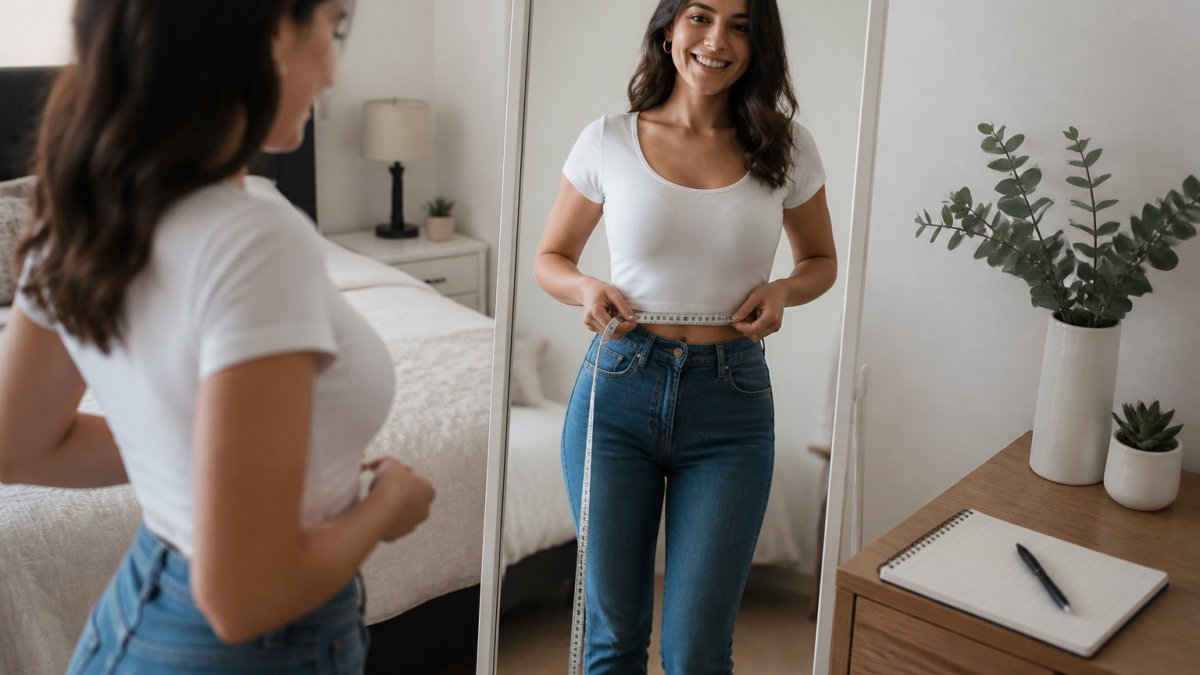
Learning how to measure for clothing size at home takes about ten minutes and one flexible tape measure. Wear fitted clothing, stand relaxed, and keep the tape snug but not tight.
Bust, Waist, Hip, and the Numbers That Matter
Three measurements do most of the work:
- Bust or chest measurement: Wrap the tape around the fullest part of your bust, keeping it level across your back.
- Waist measurement: Find your natural waist, the narrowest point above your belly button and below your ribs. Breathe normally.
- Hip measurement: Measure around the fullest part of your hips and rear, usually 7 to 9 inches below your waist.
Write each number down in inches. These three figures are the foundation of every size chart you will ever read.
Inseam, Shoulder, and Sleeve Length
For pants, measure inseam from the crotch seam of a well-fitting pair down to the hem. For tops and jackets, measure shoulder width edge to edge, and sleeve length from shoulder point to wrist bone.
Skipping these secondary measurements is a common mistake, they often separate a garment that fits from one that hangs wrong.
Reading a Women's Clothing Size Chart Like a Pro
A women's clothing size chart maps body measurements to letter or numeric sizes for a specific brand.
If your bust falls into a medium and your waist into a small, size to the larger measurement for woven fabrics, then tailor down.
Always check whether the chart lists body or garment measurements. Body measurements describe you; garment measurements describe the finished piece lying flat.
Pro Tip
Measure twice, but measure at the end of the day. Bodies shift slightly over the course of a day, and measuring in the morning can leave you with a size that feels tight by evening.
How to Find Your Size Across Brands Without Guesswork
Finding your size across brands comes down to one habit: never assume, always compare. Keep your measurements handy and check each brand's chart before ordering, no two charts are built the same way.
Pay attention to fit notes in product descriptions: phrases like "runs small" or "relaxed fit" tell you how an item behaves compared to the chart. Reviews from shoppers with similar measurements are worth more than the size label.
| Situation | What to Do | Why It Works |
|---|---|---|
| Between two sizes | Size up for woven, down for stretch | Woven fabric has no give |
| Bust and waist differ | Match the larger measurement | Tailoring down is easier |
| Brand is new to you | Check fit notes and reviews | Charts vary by brand |
| Buying denim | Compare waist, hip, and rise | Rise changes the fit |
Build a Reusable Measurement Profile
A reusable measurement profile is a saved list of your key measurements, updated once or twice a year and referenced before every purchase. Store it in your phone's notes app.
Include your bust, waist, hip, inseam, shoulder, and sleeve length, plus your preferred fit per category, and note which brands run small or large for you. This turns every future shopping session into a two-minute check instead of a gamble.
Key Takeaway
Your measurement profile is the closest thing to a universal size. Update it after any significant body change, and it will outlast every trend and relabeling.
How Clothes Should Fit Curvy Women
Clothes should fit curvy women by following the largest curve, then adjusting everywhere else. If your hips and bust are fuller relative to your waist, standard sizing often pulls, gaps, or rides up. But "curvy" is not one shape, so identify which measurement drives the fit problem, then match it to the garment category you are buying.
Start With Your Dominant Measurement
Before you shop, decide which measurement is largest relative to the brand's chart, bust, waist, or hip. That number is your anchor: match it first, then evaluate whether the garment can be adjusted at the other points.
- Bust-dominant (full bust, narrower waist and hip): Anchor to your bust. Look for tops with princess seams, bust darts, or a bit of stretch through the chest. Button-front shirts are the hardest category, check for a "full bust" or "curvy" cut, or plan to size to the bust and tailor the waist.
- Hip-dominant (full hip and rear, narrower waist): Anchor to your hip. This is the most common cause of waist gapping in jeans and trousers. Look for higher rises, contoured waistbands, or a curvy fit that removes fabric at the waist without shrinking the hip.
- Waist-dominant (fuller midsection, narrower hip): Anchor to your waist. Wrap dresses, empire waists, and A-line skirts skim rather than cling. Avoid stiff, high-waisted woven bottoms that dig in when you sit.
Why One Measurement Alone Fails
Matching a single number rarely produces a good fit because garments are cut for an assumed proportion, not for you. Jeans can match your hip exactly and still gap 2 inches at the waist if the brand's block assumes a straighter hip-to-waist ratio.
Judy Blue Full Size Mid Rise Rigid Magic Release Hem Jeans →
This is why the same person can be a medium in one brand's top and a large in another's, and why a "correct" size can still fit poorly. The label reflects the brand's block, not your body.
Petite, Tall, and Plus-Size Adjustments
Fit problems multiply when your height or proportions fall outside a brand's base pattern.
- Petite: Shorter inseams, higher waist placements, and shorter sleeve and torso lengths matter more than the size number. A petite cut shifts the waist up and shortens the rise so the knee and hem land in the right place. If a brand does not offer petite, expect to hem pants and may need to shorten sleeves.
- Tall: Look for extended inseams (often listed in inches) and longer torso lengths. A regular top on a long torso will ride up; a tall cut adds length through the body, not just the sleeve.
- Plus-size: Plus patterns are graded differently from straight sizes, with more room through the bust, waist, and upper arm. Do not assume a straight-size 16 and a plus-size 16 are the same garment, they are usually drafted from different blocks. Check the plus-specific chart rather than converting from a straight size.
Category-Specific Fit Notes for Curvy Frames
- Jeans and trousers: Prioritize rise and hip. A mid or high rise with moderate stretch and a contoured waistband sits better on a fuller hip and reduces waist gapping. Rigid denim with no stretch will expose every half-inch difference.
- Dresses: Wrap and fit-and-flare cuts accommodate a fuller bust and hip without pulling. A sheath in a stiff woven fabric is the least forgiving.
- Bras: Band size should match your underbust measurement snugly, and cup size should follow your bust-to-underbust difference. A band that rides up is too loose, regardless of cup.
Adjustments Beat Perfect Sizing
A tailor can take in a waist, shorten a hem, or adjust a strap for a modest cost, and the result usually fits better than any off-the-rack size. When a garment fits your anchor measurement but not the rest, buy for the hardest-to-alter point (usually the bust or hip) and tailor the rest. What separates a garment that flatters from one that fights you is construction and cut, not the number on the tag.
Key Takeaway
For curvy frames, anchor to your largest relevant measurement, buy for the point that is hardest to alter, and treat tailoring as a normal step, not a failure.
Between Sizes, Ease, and Fabric Stretch: What Actually Decides the Fit
Between sizes, ease and fabric stretch decide the fit more than the size number does. Ease is the extra room built into a garment beyond your body measurements, and it is why two size 10 dresses can feel completely different. Understanding ease, stretch, and construction turns "which size?" into a calculation.
Body Measurements vs. Finished-Garment Measurements
These are two different things, and mixing them up causes failed online orders.
- Body measurements describe you, the numbers you take with a tape measure.
- Finished-garment measurements describe the garment lying flat, usually given as a flat measurement (half the total circumference).
If a chart lists a 20-inch flat chest for a top, that is a 40-inch total circumference. Compare that 40 inches to your bust measurement to find the ease. A top with a 40-inch finished chest on a 38-inch bust has about 2 inches of ease, a close, fitted cut.
How Much Ease Is Built In
Ease varies by garment type and intended fit. As a rough guide:
- Fitted knits and bodysuits: little to no positive ease; they rely on stretch.
- T-shirts and casual tops: a few inches of ease for movement.
- Woven button-front shirts and blouses: more ease through the chest and shoulders so the fabric can move without straining.
When a product description says "relaxed fit" or "oversized," it is telling you the pattern added extra ease on purpose. "Slim fit" means minimal ease. Read those words as measurements, not style opinions.
Fabric Stretch, Drape, and Recovery
Three properties decide how a fabric behaves:
- Stretch: how far the fabric gives. A knit with spandex will forgive a half-inch difference that a rigid cotton will not.
- Drape: how the fabric falls. Fluid fabrics like rayon or jersey skim the body and hide small gaps; stiff fabrics like denim or canvas hold their shape and expose them.
- Recovery: whether the fabric springs back. A stretchy fabric with poor recovery will bag out at the knees and elbows over a day of wear.
A garment can be stretchy and still fit badly if it has no recovery, and a rigid garment can fit beautifully if it is cut with the right ease. That is why fabric content on the label matters as much as the size chart.
Construction Details That Change Fit
- Darts and seams: bust darts and princess seams shape fabric to a curve; without them, a woven top relies on ease alone.
- Contoured waistbands: curved to follow the hip-to-waist ratio, they reduce gapping on fuller hips.
- Bias cut: fabric cut on the diagonal drapes and stretches slightly, so a bias-cut garment often fits a range of sizes.
A Simple Decision Rule
When between sizes, ask two questions: how much stretch and recovery does this fabric have, and how much ease was built in?
- Plenty of stretch and generous ease: size down for a closer fit.
- Limited stretch or minimal ease: size up, especially for woven fabrics.
- Stretchy but poor recovery: size down cautiously, and expect some bagging.
Our Judy Blue Full Size Mid Rise Rigid Magic Release Hem Jeans offer moderate stretch and a mid rise, which helps them hold their shape while still moving with you.

Watch Out
Ignoring fabric content and finished-garment measurements before ordering is the fastest way to a return. A garment listed as highly stretchy will fit very differently from one with no stretch, even at the same labeled size.
When a chart gives a flat measurement, double it before comparing to your body measurement. A 19-inch flat waist is a 38-inch waist, not a 19-inch one.
Frequently Asked Questions
How do I measure myself for a clothing size chart?
Stand in front of a mirror wearing fitted clothing. Wrap a flexible measuring tape around the fullest part of your bust, your natural waist (the narrowest point), and the fullest part of your hips. Keep the tape snug but not tight, and parallel to the floor. Write each number down. For pants, also measure your inseam from crotch to ankle. These four numbers are the foundation of a consistent clothing size.
Why do clothing sizes vary between brands?
Brands build their own size charts, and there is no single industry standard. A medium at one label can match a large at another. Vanity sizing also plays a role, where brands adjust measurements to flatter shoppers. Fabric stretch, cut, and the intended fit (slim, relaxed, oversized) add more variation. That is why measuring your body and checking each brand's specific size chart beats relying on the letter on the tag.
Should I size up or down when I am between sizes?
It depends on the garment and fabric. For structured pieces with little stretch, like rigid denim or tailored blazers, size up and have it altered if needed. For stretchy knits, jersey, or items with an elastic waistband, size down. Check the product description for stretch level and fit notes. If the listing says 'moderate stretch' or 'highly stretchy,' that tells you the fabric will give. When in doubt, size up for comfort.
How can I find my size across different clothing brands?
Keep a written or digital measurement profile with your bust, waist, hip, inseam, and shoulder numbers. Before ordering from any brand, pull up its size chart and match your numbers to the chart, not the letter size you normally wear. Note whether the brand runs small, true to size, or large based on customer reviews. Save fit notes for every brand you buy from so you build a personal reference over time.
How should clothes fit curvy women?
Curvy fit is about proportion, not just size. Waistbands should sit flat without gapping at the back. Tops should skim the bust without pulling across the chest. Hips and thighs need room to move without the fabric straining. Look for garments cut with curve-friendly proportions, like high-waisted styles, tummy control panels, or stretch denim blends. A flattering fit follows your shape rather than fighting it.
What is the best way to take accurate body measurements?
Use a flexible tape measure, not a rigid one. Wear lightweight clothing or undergarments. Stand straight with feet together and breathe normally. Have someone help with hard-to-reach spots like the back or shoulder. Measure twice to confirm. Keep the tape level and snug, not compressing the skin. Accurate measurements are the difference between a garment that fits and one that gets returned.
Sizing inconsistency is frustrating, but it is solvable with the right measurements and a brand that builds around real bodies. Urban Mode Wear Store designs premium denim and wardrobe staples with flattering fits for every curve, plus-size friendly options, and timeless pieces that move from the office to the city. Build your measurement profile, then add to cart with confidence at Urban Mode Wear Store.