Cart
0

Table of Contents
- Why Price Doesn't Always Equal Quality
- How to Identify High Quality Clothing: 7 Physical Checks
- Signs of Poor Quality Clothing You Should Never Ignore
- The Cost Per Wear Formula: When Expensive Clothing Is Actually Cheaper
- Durability, Fit, and the Second-Hand Market Test
- How to Build a Wardrobe of Investment Pieces Without Overspending
- Conclusion: Price Is a Signal, Not a Guarantee
- Frequently Asked Questions
Last Updated: September 16, 2026
Why Price Doesn't Always Equal Quality
The short answer is no: expensive clothing is not automatically better quality. Price reflects brand markup, marketing, and positioning as much as fabric, construction, or durability. This guide from Urban Mode Wear Store breaks down how to tell the difference.
The Role of Brand Markup and Marketing
Brand markup is the gap between what a garment costs to make and what it sells for. Luxury positioning, celebrity campaigns, and prime retail space all get folded in, none of it changes the stitch count.
Consumer psychology does the rest: a higher price signals quality, so brands can charge more without improving the product. That's why price-to-value ratio matters more than price alone.
Fast Fashion vs. Slow Fashion Economics
Mass production drives fast fashion prices down by cutting material costs, speeding up cycles, and accepting shorter garment longevity. Slow fashion inverts that trade: fewer styles, better materials, higher upfront cost.
The economics favor slow fashion over time, but only if you actually wear the piece. A cheap item worn twice costs more per wear than a well-made one worn for years.
How to Identify High Quality Clothing: 7 Physical Checks
You can identify high quality clothing by inspecting seven things: fabric density, stitching, seam strength, button and hardware quality, lining, pattern alignment, and how the garment holds its shape. None require a label or price tag to evaluate.
Here's a checklist to use, in order:
- Pinch the fabric: does it feel dense or thin and papery?
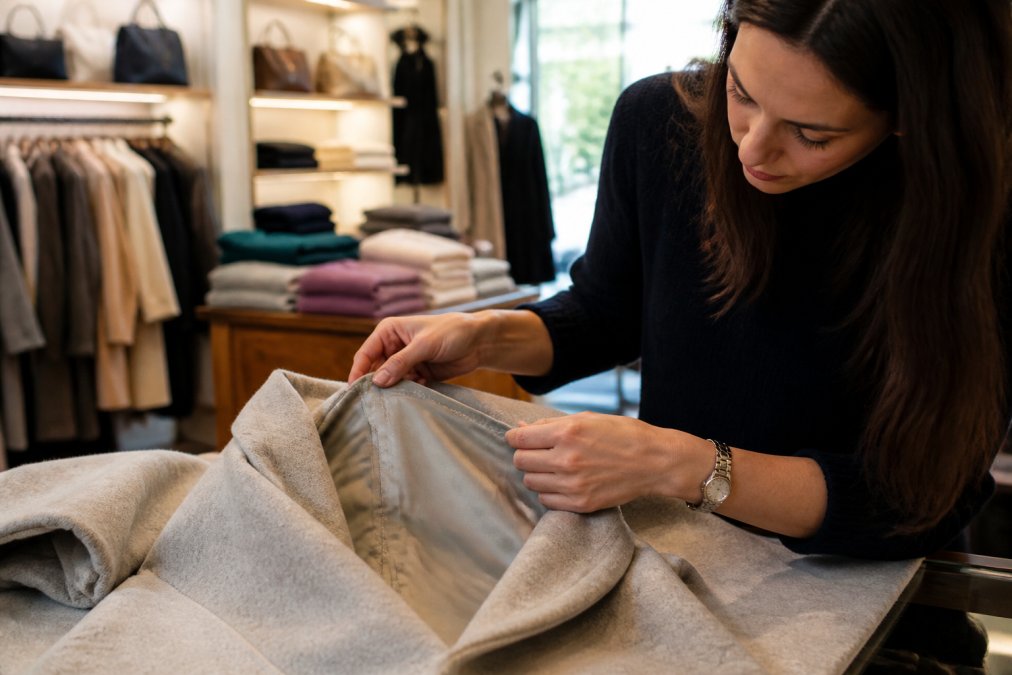
- Turn it inside out and check the seam finish
- Count stitches per inch along a main seam
- Test the buttons and zipper hardware
- Check whether patterns match at the seams
- Look for a lining in structured pieces
- Hold it up and see if it drapes or collapses
Fabric Density, GSM, and Raw Materials
Fabric density, measured in GSM (grams per square meter), tells you how much material is actually in the cloth. Higher GSM generally means a heavier, more durable fabric. Natural fibers like cotton, wool, and linen behave differently from synthetics, and each has trade-offs.
Natural fibers breathe and age well but need more care; synthetics resist wrinkling and cost less but can pill. Neither is automatically better, what matters is whether the fabric suits the garment's purpose.
Stitching Quality, Seam Strength, and Garment Construction
Stitching quality is the single most reliable quality indicator you can check in seconds. Dense, even stitches with clean seam finishes signal careful construction; loose, wavy, or skipped stitches signal the opposite.
Seam strength matters most at stress points: shoulders, armholes, and crotch seams. Don't judge by outer appearance alone, flip it inside out. The interior tells the truth.
Pro Tip
Run your thumb along the inside of a seam. If you feel a raw, unfinished edge on a garment priced as premium, the quality control stopped at the outside. Better-made pieces use bound or French seams that enclose the raw edge.
Signs of Poor Quality Clothing You Should Never Ignore
The clearest signs of poor quality clothing are thin fabric that lets light through, loose or uneven stitching, plastic-feeling buttons, mismatched patterns at seams, and hardware that sticks or wobbles. One is a warning; two or more means walk away.
Cheap zippers are the giveaway most shoppers miss. A quality zipper glides without catching and has metal teeth rather than molded plastic. Buttons should feel solid and be sewn on with a shank, not flat against the fabric. Hardware durability often outlasts everything else on a garment, or fails first.
Watch Out
Skipping the inside-out check is the most expensive mistake in clothing shopping. A garment can look flawless on the hanger and fall apart at the seams within a few washes because the interior construction was never finished. Always inspect before you buy or keep.
The Cost Per Wear Formula: When Expensive Clothing Is Actually Cheaper
The cost per wear formula divides the purchase price by the number of times you wear the item. A $60 jacket worn 60 times costs $1 per wear. A $20 jacket worn 4 times costs $5 per wear. The cheaper item was the more expensive purchase.
This is where expensive clothing can genuinely win: when a piece fits well, suits multiple occasions, and survives repeated washing, its cost per wear drops below fast fashion replacements. The math only works if you actually wear it.
Run the formula honestly and it exposes the real cost of a bad buy. A $180 blazer worn twice a month for three years lands near $2.50 per wear. A $35 blazer worn twice before the lining tears lands at $17.50 per wear, seven times the cost of the expensive piece. The sticker price told you nothing. The wear count told you everything.
Fashion Men's Casual Windbreaker →
The Diminishing Returns Threshold
There is a point where paying more stops buying better quality. Past that threshold, you're paying for the label, packaging, and prestige. Finding that threshold is the skill, and almost no buying guide will name it for you.
The threshold is not a single dollar figure. It is the price at which three things stop improving at the same rate as the number on the tag:
- Fiber content. Below the threshold, price increases track real upgrades, cotton to long-staple cotton, acrylic to wool, polyester lining to cupro or bemberg. Above it, you often find the same fiber spec at two very different prices.
- Construction labor. Stitch density, seam finishing, and pattern matching cost money to execute. Once a garment hits bound seams, matched patterns, and a full lining, additional dollars rarely buy a visibly better interior.
- Hardware and trim. Metal zippers, corozo or horn buttons, and reinforced stress points are a fixed cost. A brand charging triple for the same YKK zipper and the same button shank is selling positioning, not product.
To locate the threshold for any category, compare the specification sheet, not the price tag.
Key Takeaway
Cost per wear is the only pricing comparison that matters. Judge every purchase by total wears, not sticker price, and once two garments share the same fiber, lining, and stitch density, assume you are paying for the label, not the cloth.
The Hidden Cost of Care
Cost per wear has a second variable most formulas ignore: maintenance. Expensive clothing often requires specialized care, and that cost belongs in the math.
The Second-Hand Market Test
Resale value is the most objective quality signal available, because it is set by strangers with no stake in the sale. Second-hand market value reflects what other buyers believe a garment is worth after it has been worn, and that belief tracks durability, construction, and timeless design far more reliably than any marketing claim.
Durability, Fit, and the Second-Hand Market Test
Durability and fit are the two qualities that survive a garment's first season. Both are testable before you buy. And both show up in resale value.
How to Test Durability Before You Buy
Durability is not a feeling. It is a set of measurable properties you can check in the fitting room in under two minutes.
Fit Is a Durability Issue, Not Just a Style One
Fit and silhouette deserve equal weight. A well-constructed garment that doesn't fit is still a bad purchase. Tailoring can fix some issues, but not all: seam strength and stitching can be repaired; a fundamentally wrong cut cannot.
The Second-Hand Market Test
Second-hand market value is an underused quality signal. Investment pieces from well-made labels hold resale value because buyers know they last; fast fashion pieces resell for almost nothing because everyone knows they won't. Retained resale value is third-party proof of garment longevity.
How to Build a Wardrobe of Investment Pieces Without Overspending
Building a wardrobe of investment pieces means buying fewer garments with higher cost-per-wear value, not the most expensive option available. The goal is a small core of versatile pieces that work across settings.
A practical approach:
- Identify the 5-7 pieces you wear most often
- Replace them first, one at a time, with better-constructed versions
- Check fabric density and seam finish before buying
- Calculate cost per wear before committing
- Skip trend-driven pieces unless they fit an existing gap
- Buy second-hand for investment pieces when condition allows
Conclusion: Price Is a Signal, Not a Guarantee
Price tells you what a brand thinks its product is worth. It doesn't tell you how many washes the seams will survive or whether the fabric will pill by month three. That information lives in the garment itself, and it's readable if you know where to look.
Frequently Asked Questions
Is it worth buying expensive clothing?
It depends on construction, materials, and how often you wear the piece. Expensive clothing is worth it when fabric density, stitching quality, and fit hold up over years of wear. A $200 coat worn 100 times costs $2 per wear, while a $40 coat worn 10 times costs $4 per wear. Price alone does not guarantee quality, so check the garment itself before deciding.
What is the 3-3-3 rule for clothing?
The 3-3-3 rule is a wardrobe guideline: buy pieces you can wear for three months, three years, or three seasons. It forces you to think about garment longevity and cost-per-wear before purchasing. If a piece only works for one trend cycle, it fails the test. If it transitions across seasons and settings, it earns its place in your closet.
How can you tell if a garment is well-made?
Check the seams, buttons, and fabric weight. Well-made garments have tight, even stitching with no loose threads. Buttons and hardware should feel secure and substantial. Fabric should have some density and texture rather than feeling thin or slippery. Examine the inside of the garment, not just the outside, because hidden construction details reveal true quality.
Does price always correlate with fabric durability?
No. Brand markup, marketing, and luxury positioning inflate prices without improving fabric. A $300 blouse made from the same synthetic blend as a $60 version will not last longer. Natural fibers like cotton, wool, and linen generally outperform synthetic blends for durability, but only if the fabric density and construction match. Always inspect the material and stitching before trusting the price tag.